
Unveiling the Hidden Earthquakes Beneath Yellowstone: A Breakthrough in Seismic Research
A groundbreaking study has revealed the presence of tens of thousands of hidden earthquakes beneath the Yellowstone volcano, shedding new light on the seismic activity of the region. By utilizing artificial intelligence (AI) to analyze 15 years of seismic data, a team of international scientists has successfully detected over 86,000 mini-earthquake events that went undetected for years. This discovery not only provides valuable insights into the Yellowstone seismicity but also has significant implications for monitoring and preparing for potential future risks.
A look at the United States’ first National Park: Yellowstone.
The research, published in Science Advances, employed a machine-learning approach to sift through the vast amounts of seismic data, identifying the arrival of earthquake waves and detecting very small earthquakes that were previously undetected. This innovative technique has enabled scientists to create a 3D map of the Earth, providing a precise location of the previous undetected seismic activity. According to David Shelly, a seismologist with the U.S. Geological Survey (USGS), “By measuring, essentially, the timing of those arrivals and doing that at stations that are located in different places, well, you can both know that an earthquake happened, but then you can also determine where that earthquake happened in three-dimensional space.”
Yellowstone: A Volcanic System of Unparalleled Power
Formed over 640,000 years ago, Yellowstone is one of the largest active volcanoes in the world, with a caldera spanning 30 by 45 miles and containing over 10,000 geothermal features. The sheer scale of this volcanic system is awe-inspiring, with the potential to cause catastrophic damage if it were to erupt. In fact, a Yellowstone eruption would cover two-thirds of the United States, rendering the entire country uninhabitable for years. The Grand Prismatic Spring, the largest hot spring in Yellowstone National Park, is a testament to the park’s unique geothermal features.
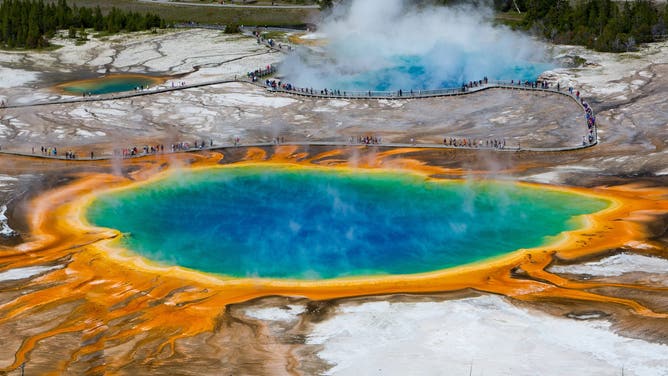
The largest hot spring in Yellowstone National Park is Grand Prismatic Spring.
(Inger Vandyke / VW PICS / Universal Images Group / Getty Images)
Earthquake Swarms: A Key to Understanding Yellowstone’s Seismicity
The study revealed that 52% of the seismic events are linked to earthquake swarms, which are groups of small, interconnected earthquakes that occur over an extended period. These swarms can last from days to weeks, but the research found that swarms that happened years apart can still occur in nearly the same physical location. According to Shelly, “We think much of this activity is triggered by fluids, basically water moving deep in the earth where the earthquakes are happening.” This breakthrough has significant implications for monitoring and preparing for potential future risks, as it provides a better understanding of the long-term behavior of the Yellowstone volcanic system.
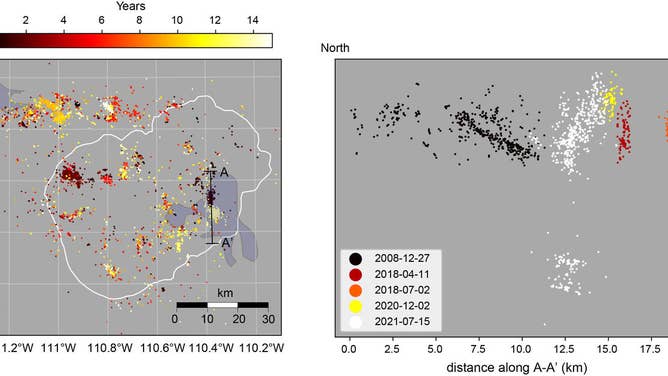
The map shows the relocated Yellowstone seismicity recorded from 2008 to 2022.
(Yellowstone Volcano Observatory / FOX Weather)
Implications and Future Directions
The discovery of these hidden earthquakes has far-reaching implications for the field of seismology and beyond. The breakthrough AI tools used in this study can be applied to monitor hidden earthquake swarm patterns around the world, providing critical insights into the seismic activity of other volcanic systems. As Shelly notes, “We monitor earthquakes as disaster preparedness and response. And so, certainly in that context, these tools are helping with the things that we do kind of every day in that realm.” By continuing to advance our understanding of seismic activity, we can better prepare for and respond to potential natural disasters, ultimately saving lives and reducing the impact of these events.
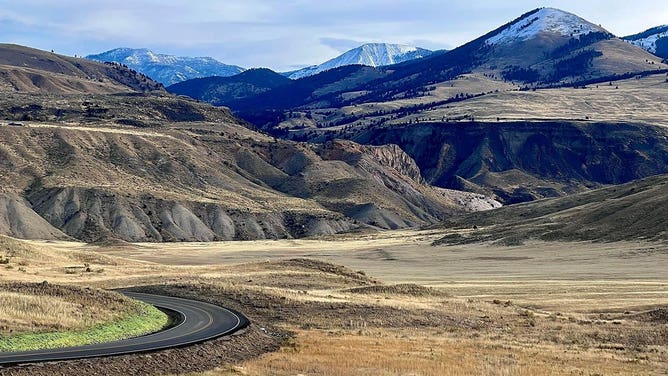
A road cuts through the majestic landscape of Yellowstone National Park in 2022.
(Robert Ray / FOX Weather)
For more information on this groundbreaking study, visit Here
Image Source: www.foxweather.com


