
A Miracle Birth: Cassandra King’s Journey with Spontaneous Coronary Artery Dissection
Cassandra King was overjoyed to have completed her first trimester of pregnancy in the fall of 2024, after years of trying to conceive and experiencing multiple miscarriages. To celebrate, she and her husband decided to take a babymoon to Jamaica during her 17th week of pregnancy.
Initially, the trip was going smoothly, with King only experiencing minor pregnancy discomfort. However, on their final night, she felt a sudden and severe burning pain in her shoulder, which radiated down her spine. The pain was so intense that she vomited for two hours before seeking medical attention at a local hospital.
King was terrified and in agony, pleading with the medical staff to check on her baby’s well-being. She was still in the early stages of her pregnancy and hadn’t felt her baby kick yet, making her even more anxious. The medical team soon discovered that King had suffered a spontaneous coronary artery dissection, a rare and life-threatening cardiac event caused by a tear in an artery.
A Critical Situation
King’s condition was critical, with her heart only pumping out about 25% of its volume, compared to the normal 55-60%. Her pregnancy was putting additional strain on her body, and doctors recommended terminating the pregnancy to save her life. However, King was adamant that she couldn’t consider this option, having invested three years of her life into trying to conceive.
A team of medical professionals, led by cardiothoracic surgeon Dr. Bartlomiej Imielski, worked together to develop a plan to support King and her baby. They decided to use medication to stabilize King’s condition and, if necessary, employ a device called the Impella 5.5 to help her heart pump blood. The goal was to keep King and her baby stable until the fetus was viable outside the womb, around 24 weeks.
The Impella 5.5 had only been used in a handful of pregnancy-related cases before, and never in a situation like King’s, where the patient was still in the early stages of pregnancy. The medical team was aware of the risks and uncertainties, but they were determined to explore all options to save both King and her baby.
A Delicate Balance
King’s condition remained precarious, with her heart still not pumping efficiently. She experienced chest pain, swelling, and shortness of breath, and was readmitted to the hospital on New Year’s Eve. The medical team decided to proceed with the Impella 5.5 procedure, which was a high-risk operation that required careful planning and execution.
The procedure was complex, with over 20 medical professionals involved. King’s blood pressure dropped during the operation, and her baby showed signs of distress. The medical team had to act quickly, putting King on life support to complete the procedure safely.
A Miracle Baby
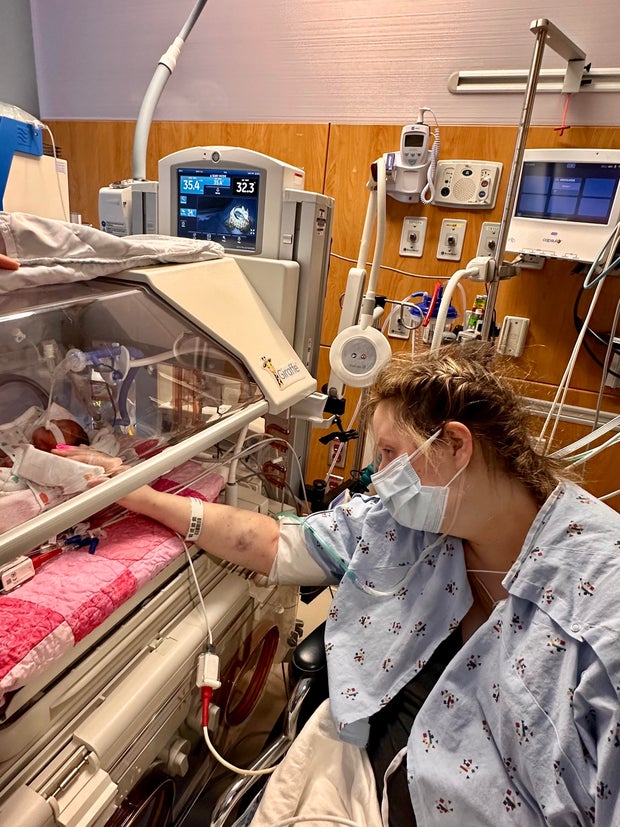
King spent 13 days in the ICU, with the Impella 5.5 keeping her heart functioning. Her baby, Persephone, was born via C-section at 27 weeks, weighing just two pounds, four ounces. Despite the challenges, Persephone was breathing on her own and doing well.
A New Beginning
King’s heart pump was removed three days after Persephone’s birth, and she was discharged from the hospital five days later. Persephone spent three months in the NICU before being released in March. King has since undergone cardiac rehabilitation and has regular check-ups to monitor her condition.
Today, Persephone is a happy and healthy one-year-old, and King is grateful for the opportunity to be her mother. King’s experience has also contributed to the advancement of medical knowledge, and her case may help pave the way for future research and treatment options for women with similar conditions.

Learn more about this incredible story and the medical team that made it possible Here
Image Source: www.cbsnews.com


