
NASA’s James Webb Space Telescope Uncovers Unexpected Activity on Jupiter and Moon Formation Around Exoplanet
Recent images captured by NASA’s James Webb Space Telescope have revealed unexpected activity in the atmosphere of Jupiter, showcasing massive aurora lights on the gas giant. The James Webb Space Telescope, launched in December 2021, is the world’s premier space science observatory, aimed at studying the history of the universe through state-of-the-art technology.
The telescope has also measured a potential moon-forming disk encircling an exoplanet, providing researchers with a unique opportunity to observe and study moon formation as it happens. This discovery allows for a better understanding of planet and moon formation, which is fundamental to understanding the evolution of planetary systems. 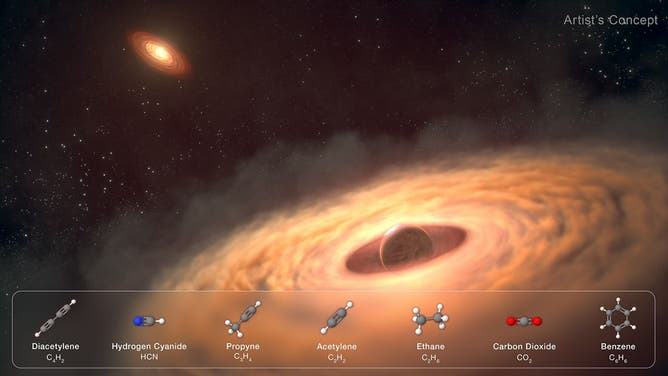 The planet, called CT Cha b, is located 625 light-years away from Earth and is accompanied by a dust and gas ring that data suggests features the raw materials for moon formation.
Moon Formation and the Evolution of Planetary Systems
The substantial discovery of the “possible construction yard for moons” enables researchers to compare the birth of our solar system more than 4 billion years ago to the formation of other planetary systems. While the carbon-rich disk has the potential to form moons, no moons have been detected, according to Webb data, giving researchers the opportunity to study and calculate the formations of moons and the young planet as it occurs. This discovery is a significant step forward in understanding the evolution of planetary systems and the formation of moons.
The James Webb Space Telescope has been delving deeper into our universe than ever before, providing unprecedented insights into the history of the universe. The telescope’s advanced technology has enabled researchers to study the formation of planets and moons in greater detail than ever before.  For more information on this discovery and the James Webb Space Telescope, visit Here
Image Source: www.foxweather.com


