
NASA’s Artemis Program: A New Era in Space Exploration
NASA announced the selection of three commercial companies to help advance the agency’s Artemis program, which aims to return humans to the Moon by 2030. The space agency plans to use a lunar terrain vehicle during the Artemis V mission, marking a significant milestone in the program. As NASA prepares for the Artemis II lunar mission, the agency has unveiled a state-of-the-art facility that will monitor the spacecraft’s every move.
Located inside NASA’s iconic Mission Control Center in Houston, the Mission Evaluation Room (MER) will house teams of engineers to evaluate Orion’s performance throughout its expected 10-day mission. The Orion spacecraft is expected to carry NASA astronauts Reid Wiseman, Victor Glover, and Christina Koch, alongside Canadian Space Agency astronaut Jeremy Hansen, on a journey around the Moon and back to Earth. This mission will be the first time humans will leave low-Earth orbit since Apollo 17 in 1972, and is expected to lift off around April 2026.
According to Trey Perryman, one of the leads on the Orion mission at the Johnson Space Center, “The operations team is flying the spacecraft, but they are relying on the Mission Evaluation Room’s reachback engineering capability from the NASA, industry, and international Orion team that has designed, built, and tested this spacecraft.” The new facility officially opened just days before a major simulation exercise that tested the staff’s ability to respond to different scenarios.
NASA’s New Mission Room: A Hub for Space Exploration
During an actual mission, NASA says staff will operate in rotating shifts, beginning 48 hours before launch and continuing nonstop until Orion has been safely recovered by Navy personnel in the eastern Pacific. Should any unexpected issues arise in flight, the MER will be equipped to coordinate support from other NASA facilities, Lockheed Martin, the European Space Agency, and others. Post-flight evaluations from the Artemis II flight and data collected by Mission Control and the new MER center are expected to play a crucial role in a potential lunar landing and any subsequent missions into the solar system.
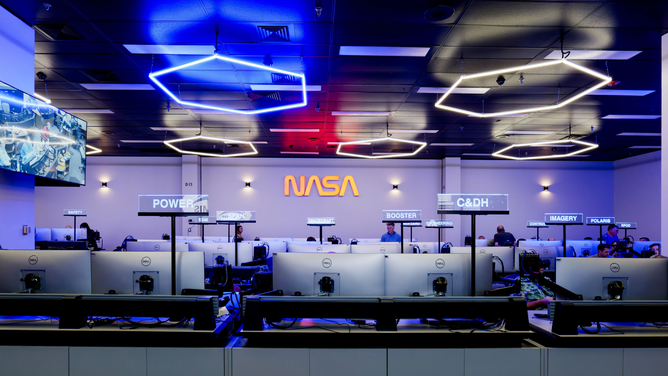
Photo of NASA’s new mission room in Houston, Texas.
(NASA)
“Data collection is hugely significant,” Perryman stated. “We’ll do an analysis and assessment of all the data we’ve collected, and compare it against what we were expecting from the spacecraft.” The Artemis II mission is a critical step towards NASA’s goal of establishing a sustainable presence on the Moon and eventually sending humans to Mars.
Challenges and Uncertainties Ahead
It remains unclear when NASA will grant clearance for the Artemis II mission to proceed with preparations for launch. The Artemis I mission, which flew an uncrewed spacecraft around the Moon in 2022, is still undergoing an in-depth review, with concerns centered on the integrity of the critical heat shield. Further complicating the Artemis II timeline, the agency has been led by interim leadership since early 2025, leaving uncertainty over when a permanent administrator will be appointed to provide guidance on the Moon program and other space exploration.
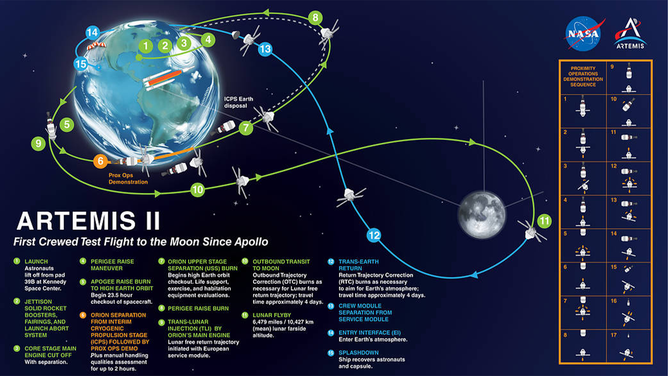
Artemis II timeline
(NASA)
For more information on NASA’s Artemis program and the latest updates on the mission, visit Here
Image Source: www.foxweather.com


