
Introduction to November Skywatching
As the month of November begins, millions of people across the United States will have the opportunity to witness some of the most spectacular astronomical events of the year. This month is shaping up to be a great time for skywatching, with a Supermoon and two meteor showers visible in the night sky. In this article, we will explore the details of these events and provide information on how to make the most of your skywatching experience.
Dash camera video from Wednesday night in Neenah, Wisconsin showed a meteor flashing across the night sky. This November, millions across the U.S. will get a chance to see the biggest and brightest Supermoon as well as a pair of meteor showers through the night sky.
November 5: Must-See Supermoon
November kicks off with a midweek Supermoon, dubbed the Full Beaver Moon, on Nov. 5 that you will not want to miss. The Full Beaver Moon will peak around 8:20 a.m., so North America will have to watch for the Moon either the night before or after its official peak.
This Supermoon is set to illuminate the sky as the brightest and largest Moon of 2025. According to the Farmer’s Almanac, there are varying thoughts about how November’s event got its nickname. Some believe it originated because of traps put out by Native Americans to capture beavers, while others believe it comes from beavers building their winter dams before waterways freeze.
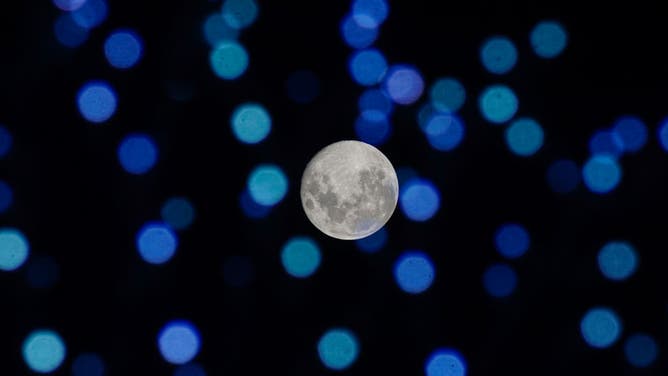
The Beaver moon is seen through Christmas lights from the historic center on November 28, 2023 in San Salvador, El Salvador. (Photo by APHOTOGRAFIA/Getty Images)
(Getty Images)
Understanding Supermoons
A Supermoon occurs because the Moon’s orbit of Earth is not a perfect circle but elliptical. During its 27-day orbit, the Moon reaches its closest point to Earth, known as perigee, and its farthest, known as apogee. When perigee coincides with the full Moon, we have a Supermoon. According to NASA, this term isn’t an astronomical definition but is usually used to describe a full Moon within at least 90% of its closest point in orbit to Earth.
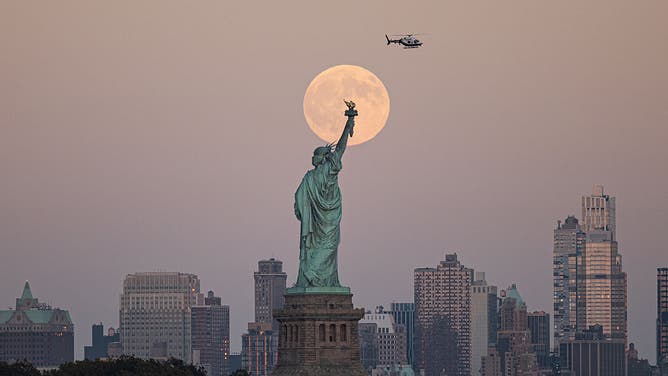
FILE: The full Harvest Supermoon rises behind the Statue of Liberty in New York City on October 7, 2025, as seen from Jersey City, New Jersey. (Photo by Lokman Vural Elibol/Anadolu via Getty Images)
(Lokman Vural Elibol/Anadolu / Getty Images)
November Meteor Showers
The Southern Taurids will be active through Nov. 20 and are expected to peak on Nov. 5, when the fireball swarm component peaks, according to the American Meteorogical Society. Rich in fireballs, Southern Taurids streak across the sky.
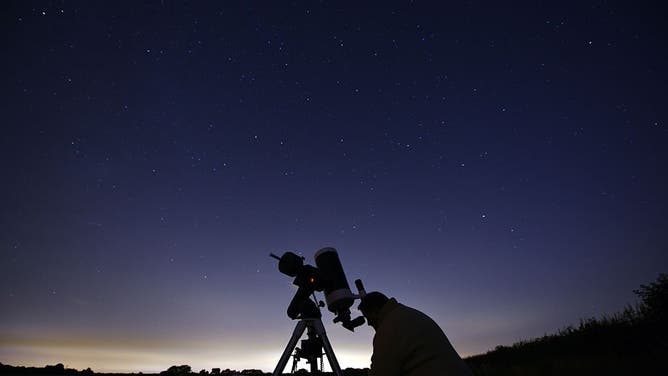
FILE: Members of the York Astronomical Society prepare to view the annual Perseids meteor shower in the village of Rufforth, near York, northern England on August 12, 2015. The Perseids meteor shower occurs every year when the Earth passes through the cloud of debris left by Comet Swift-Tuttle.
(Photo credit should read OLI SCARFF/AFP via Getty Images / Getty Images)
Leonid Meteor Shower Peak
November’s can’t-miss skywatching lineup includes the Leonid meteor shower peak in mid-November on Nov. 16 and 17. Considered a major meteor shower, the Leonids have notably lit up the skies and have a storied history of meteor storms producing a spectacular show.
Under ideal conditions, the Leonids will peak between midnight and sunrise on Nov. 17. The waning Moon will help to not interfere with the show, which began in early November and will end in early December.
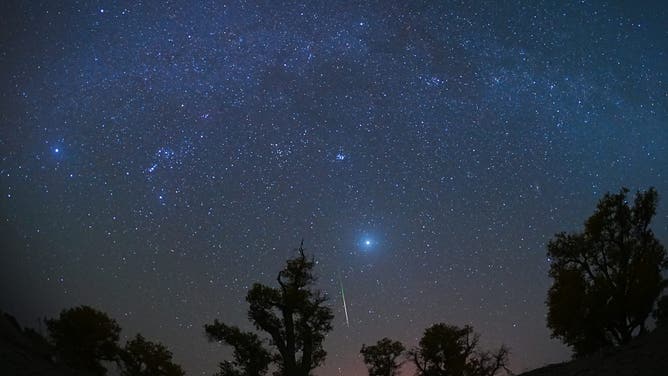
FILE: YULI, CHINA – OCTOBER 22: A meteor streaks across the sky over a desert during the Orionid meteor shower on October 22, 2023 in Yuli County, Bayingolin Mongol Autonomous Prefecture, Xinjiang Uygur Autonomous Region of China.
(VCG/VCG )
Orionid Meteor Shower
Although the Orionids peaked in late October, they will be active until Nov. 7. The Orionids can sometimes also produce fireballs, so look for bright explosions of light when viewing.
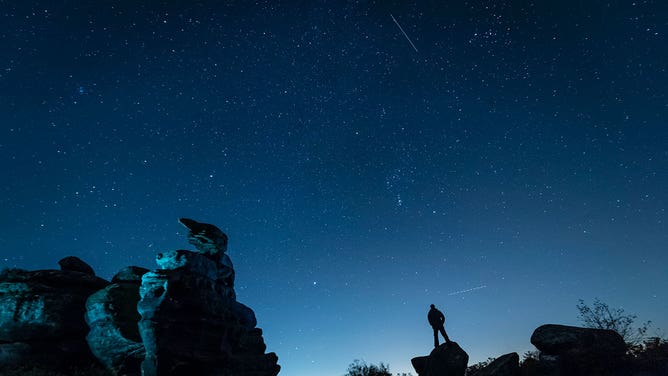
A plane and a Satellite pass by as a man stargazes at Brimham Rocks in Yorkshire as the Orionid meteor shower reaches its peak.
(Danny Lawson/PA Images via Getty Images)
For more information on these astronomical events, visit Here
Image Source: www.foxweather.com


