
Introduction to the Harvest Supermoon
The night sky is set to be illuminated by a series of four consecutive Supermoons, starting with the Harvest full Moon, which will be at its fullest just before midnight on Tuesday. This phenomenon occurs when the Moon is full at its nearest point in its elliptical orbit around the Earth. The Moon will appear about 30% brighter and 14% larger than a typical full Moon due to its proximity to Earth, which will be approximately 224,600 miles away, compared to the average distance of 238,900 miles.
According to NASA, the term “Supermoon” is not an astronomical definition but is usually used to describe a full Moon within at least 90% of its closest point in orbit to Earth. This term was coined to describe the Moon’s appearance when it is at its closest point to Earth, making it appear larger and brighter than usual.
What is a Supermoon?
A Supermoon occurs because the Moon’s orbit of Earth is not a perfect circle but elliptical. During its 27-day orbit, the Moon reaches its closest point to Earth, known as perigee, and its farthest, known as apogee. When perigee coincides with the full Moon, we have a Supermoon. This phenomenon is not unusual and can happen several times a year, with the next full Moons for November and December also being Supermoons.
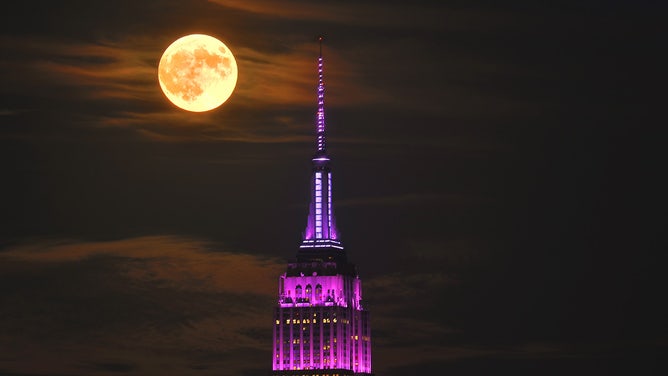
FILE: The full Harvest Supermoon rises behind the Empire State Building in New York City on September 17, 2024, as seen from Union City, New Jersey. (Gary Hershorn / Getty Images)
Impact of the Supermoon on Coastal Flooding
October’s Supermoon is expected to have an impact on the current coastal flooding occurring throughout the Southeast. Unusually high tides are partially driven by the full Moon’s gravitational pull. Tide levels will peak by midweek, just after the full Moon. Due to the astronomical influence creating King Tides, weather alerts, including Coastal Flood Advisories and Rip Current Statements, are posted from the Carolinas through Florida.
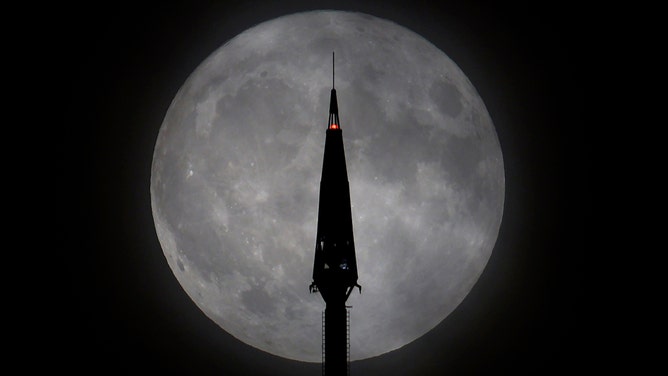
FILE: The Blue Supermoon rises behind the antenna on top of One World Trade Center in New York City on August 30, 2023, as seen from Jersey City, New Jersey. (Gary Hershorn / Getty Images)
Conclusion
In conclusion, the Harvest Supermoon is a spectacular phenomenon that will illuminate the night sky, and its impact on coastal flooding should not be underestimated. For more information on the October Harvest Supermoon and its effects, please visit Here
Image Source: www.foxweather.com


