
Revamping the Hurricane Scale: A New Approach to Storm Severity
A USF professor is pushing for a revamped hurricane scale to include storm surge and flooding criteria instead of just relying on sustained wind speeds. For decades, the Saffir-Simpson Hurricane Wind Scale has served as the only way to categorize hurricanes, ranking cyclones from Category 1 to 5 based on sustained wind speeds, but researchers say the focus on winds leaves out hazard impacts such as storm surge and flooding from rainfall.
Instead, researchers at the University of South Florida have proposed what they call the Tropical Cyclone Severity Scale, which has separate categories for wind, storm surge and precipitation. Jennifer Collins, a hurricane researcher and professor at USF’s School of Geosciences, said the need for changes stems from the fatalities associated with a storm’s water impacts. “Storm surge accounts for closer to 50 percent of fatalities. So why not have a scale that is more than just wind alone. And some of my evacuation studies have actually shown that people will use that category from this from the Saffir Simpson Hurricane Wind Scale to make their decision to evacuate or not,” Collins stated.
A USF professor is pushing for a revamped hurricane scale to include storm surge and flooding criteria instead of just relying on sustained wind speeds.
A New Perspective on Hurricane Severity
A previous study by forecasters at the National Hurricane Center found that powerful winds created by storms are responsible for less than 10% of direct deaths. Researchers highlighted Hurricane Florence in 2018 as a prime example of shortcomings with the Saffir-Simpson Hurricane Wind Scale. The cyclone maxed out at Category 4 strength while over the open Atlantic but weakened to a Category 1 before its landfall near the North Carolina–South Carolina border.
Researchers believe the lower rating caused some residents to remain in place or even return early, thinking that a weaker storm would be less detrimental. According to NOAA, the hurricane caused 54 deaths and resulted in more than $24 billion in damage, with much of the destruction tied to Florence’s catastrophic flooding. Another unique feature of the proposed scale is the introduction of a Category 6 designation, for hurricanes that produce both catastrophic flooding and wind damage.
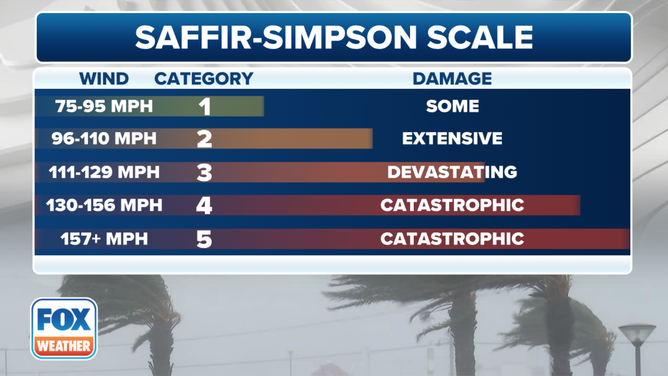
Saffir Simpson Hurricane Wind Scale and Damage
(FOX Weather)
Enhancing Disaster Messaging
Researchers say surveys have found participants were better able to identify the primary hazards of a storm while using the proposed rating system compared with the one currently in place. A proposed major change to the Saffir Simpson Wind Scale is not currently under consideration by NOAA or the National Hurricane Center, but in recent years the agency has taken steps to enhance disaster messaging.
For instance, the NHC now publishes forecast cones with inland watches and warnings, in an effort to broaden the safety message beyond the immediate coastline. Advocates for the revamped scale emphasize that any new system could complement existing NHC products rather than replace them, which would help to cut down on confusion during the rollout period.
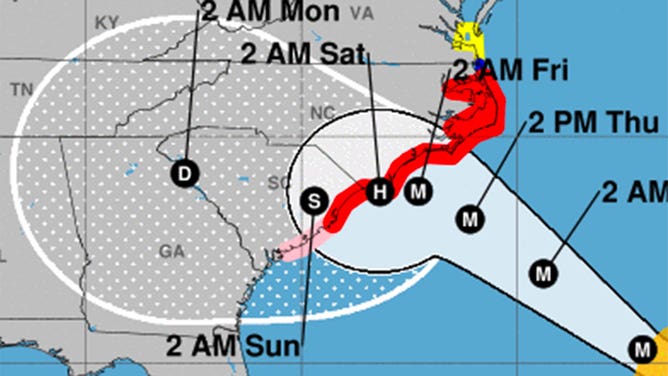
The cone of uncertainty for Hurricane Florence in 2018 is seen in this graphic.
(NHC / FOX Weather)
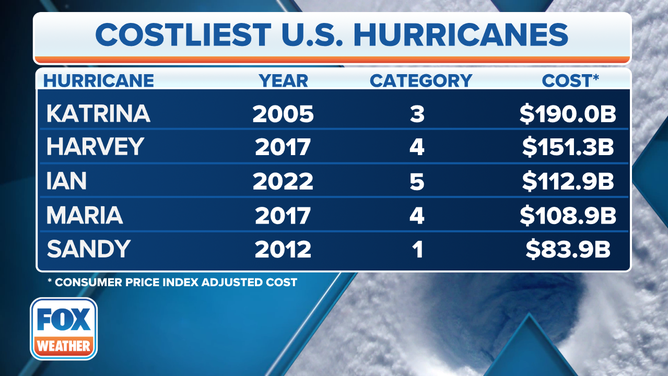
A list of the five costliest hurricanes in U.S. history.
(FOX Weather)
Read more about the proposed Tropical Cyclone Severity Scale Here
Image Source: www.foxweather.com


