
Uncovering the Secrets of Ancient Tropical Storms and Their Impact on Baby Pterosaurs
Researchers have long been fascinated by the mysteries of the ancient world, and a recent study has shed new light on the powerful forces that shaped the lives of baby pterosaurs. Tropical cyclones have been a force to be reckoned with for millions of years, and paleontologists have turned to the smallest reptile fossils to reveal the devastating impact of these storms. The study, conducted by the University of Leicester, focused on two tiny pterosaurs, nicknamed Lucky and Lucky II, which were preserved in the 150-million-year-old Solnhofen Limestones of southern Germany.
The conditions in the Solnhofen Limestones were perfect for preserving these tiny flying reptiles, with over 500 examples of pterosaurs found in the region over the last 250 years. The study’s lead author, Rab Smyth, noted that “Pterosaurs had incredibly lightweight skeletons. Hollow, thin-walled bones are ideal for flight but terrible for fossilization.” Despite the challenges of preserving these delicate creatures, the researchers were able to use UV light to perform post-mortems, revealing the same injury to both Lucky and Lucky II.
The Power of Tropical Storms
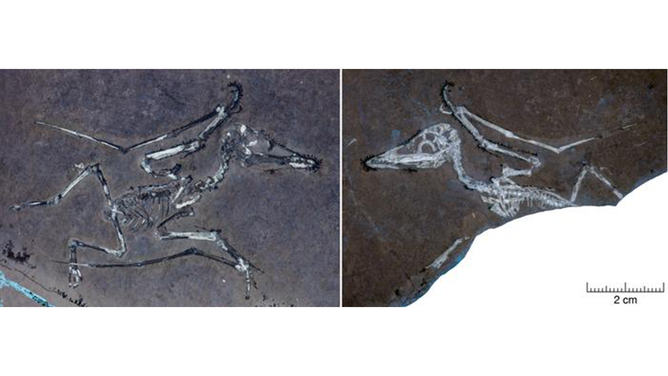 The hatchling Pterodactylus, nicknamed Lucky, illuminated UV light. Both part and counterpart show the delicate bones of this tiny pterosaur, capturing a fractured wing in extraordinary detail.
The study found that the injuries sustained by Lucky and Lucky II were consistent with being caught in a powerful tropical storm. The researchers believe that the storms helped preserve the creatures as they sank to the seafloor, creating poor conditions for scavenging and decomposition but creating the perfect environment for their delicate skeletal remains. According to the study, “Storm-generated mud rapidly buried these organisms, ensuring fossilization. As with most exceptionally preserved Solnhofen fossils, the specimens discussed here were recovered from the base of these storm deposits.”
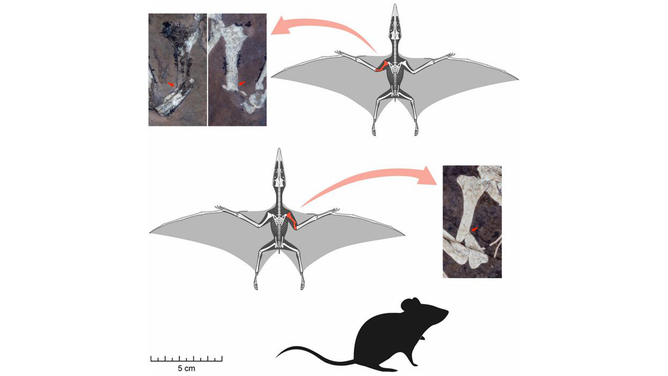 Skeletal reconstructions of the two Pterodactylus hatchlings are shown in flight position, with broken bones marked in red. UV images reveal clear breaks in the upper arm bones. A silhouette of a house mouse (Mus musculus) is included for scale.
A New Understanding of Ancient Ecosystems
The study’s findings have significant implications for our understanding of ancient ecosystems. The researchers believe that many of the pterosaurs found in the Solnhofen Limestones were not native to the lagoon, but rather were caught in storms and deposited there. According to Smyth, “For centuries, scientists believed that the Solnhofen lagoon ecosystems were dominated by small pterosaurs. But we now know this view is deeply biased. Many of these pterosaurs weren’t native to the lagoon at all. Most are inexperienced juveniles that were likely living on nearby islands that were unfortunately caught up in powerful storms.”
The study provides a fascinating glimpse into the lives of ancient creatures and the powerful forces that shaped their world. For more information on this study and its findings, visit Here
Image Source: www.foxweather.com


